


Healthcare AI has moved past experimentation. Health tech companies are now building, buying, and deploying models that interpret clinical data. But readiness has not kept pace with ambition. While most healthcare organizations use AI, many lack the data, workflows, and governance required to support outputs that are accurate, explainable, and clinically useful.
New survey data from 100 U.S.-based healthcare technology and software companies shows a market moving quickly while still working through the foundations needed for safe, scalable use.
The findings point to three implementation gaps: clinical context, trust, and infrastructure.
1. Healthcare AI is advancing faster than clinical context can keep up
The survey indicates broad AI activity across health tech. More than one-third of respondents have AI models in production interpreting clinical data. Others are using third-party or open-source models, while some are actively building and evaluating models.
Nearly all respondents said their products ingest, generate, transform, or consume data from provider documentation. Most models interpret a hybrid of unstructured text and codes, where meaning depends on nuance: laterality, acuity, severity, complications, and whether a condition is active, historical, suspected, or ruled out.
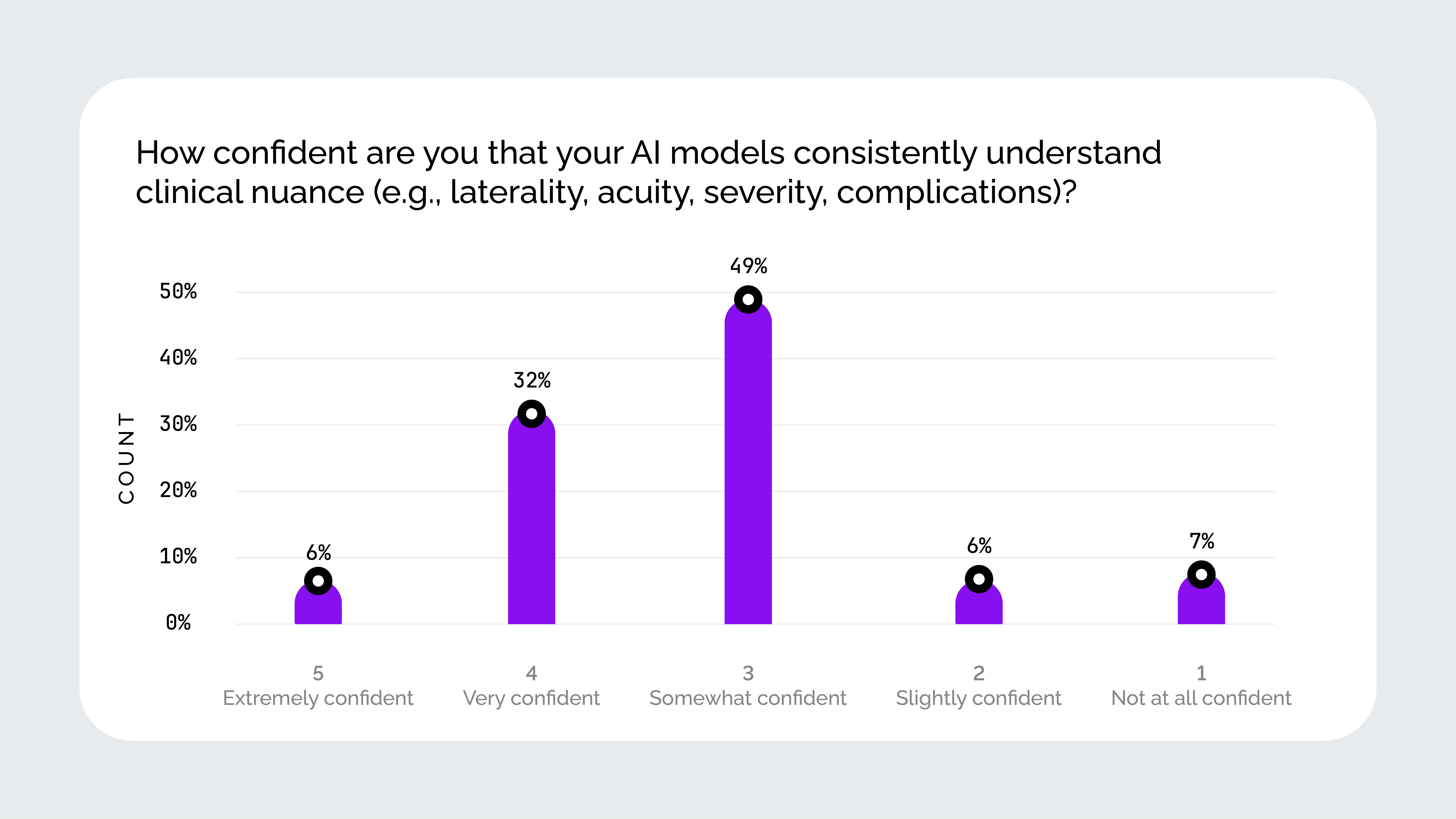
But confidence has not caught up. Only a small group of respondents reported being extremely confident that their AI models consistently understand clinical nuance. This is where an intelligent solution comes into play – one that can turn fragmented documentation into structured, contextualized clinical data for more precise AI outputs.
2. Trust is now the bottleneck to scale
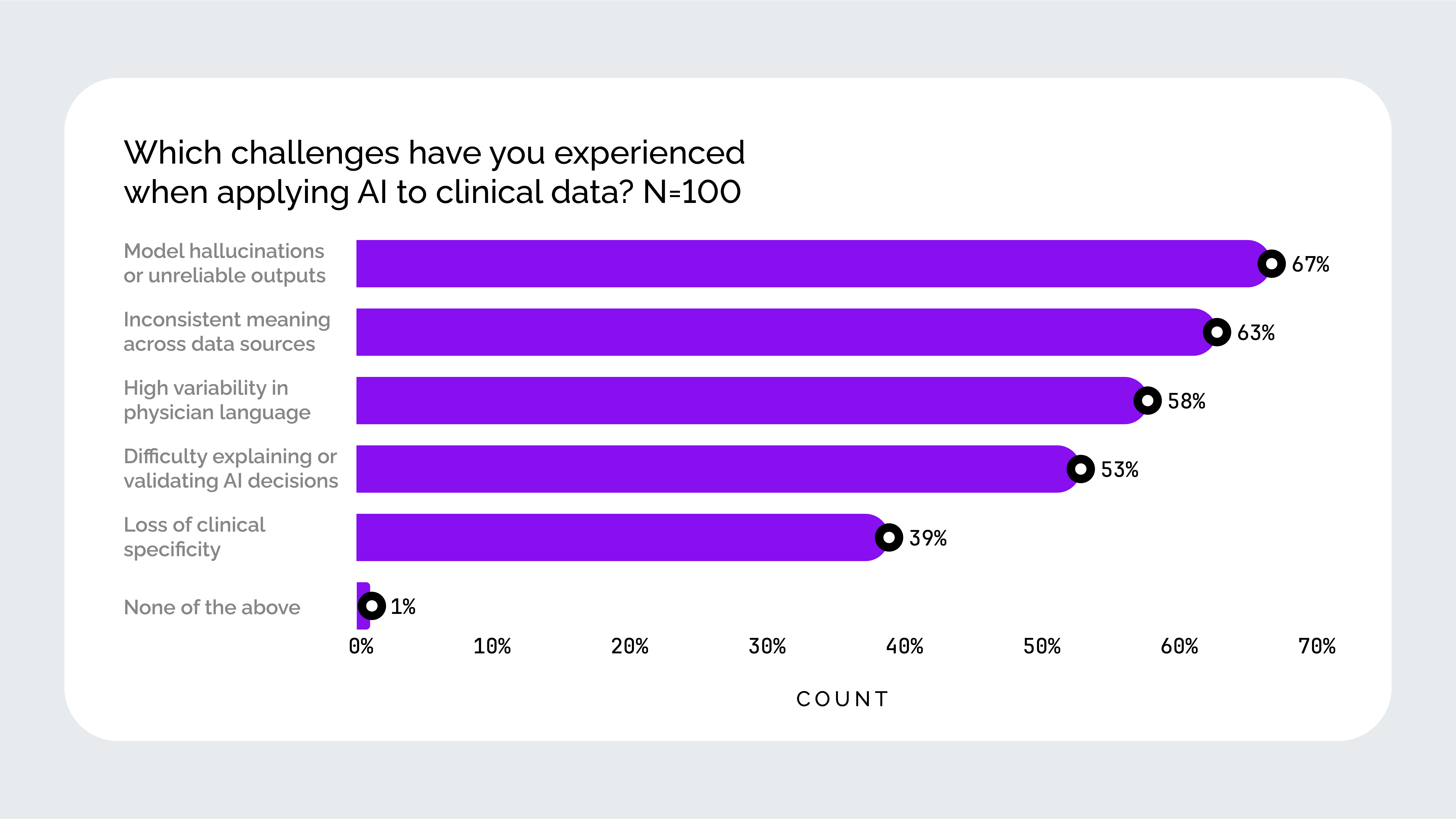
The top challenges respondents reported were hallucinations or unreliable outputs, inconsistent meaning across data sources, variable physician language, difficulty explaining or validating AI decisions, and loss of clinical specificity. These barriers determine whether clinical AI can move from prototype to trusted product capability.
Healthcare AI must preserve the clinical meaning that drives downstream decisions. If a system misses severity, collapses distinct diagnoses, strips away specificity, or cannot explain its output, it may be technically impressive but operationally fragile.
IMO Health’s clinical terminology and Knowledge Graph are built to maintain specificity, context, and traceability as data moves from documentation into analytics, coding, AI, and patient-facing workflows.
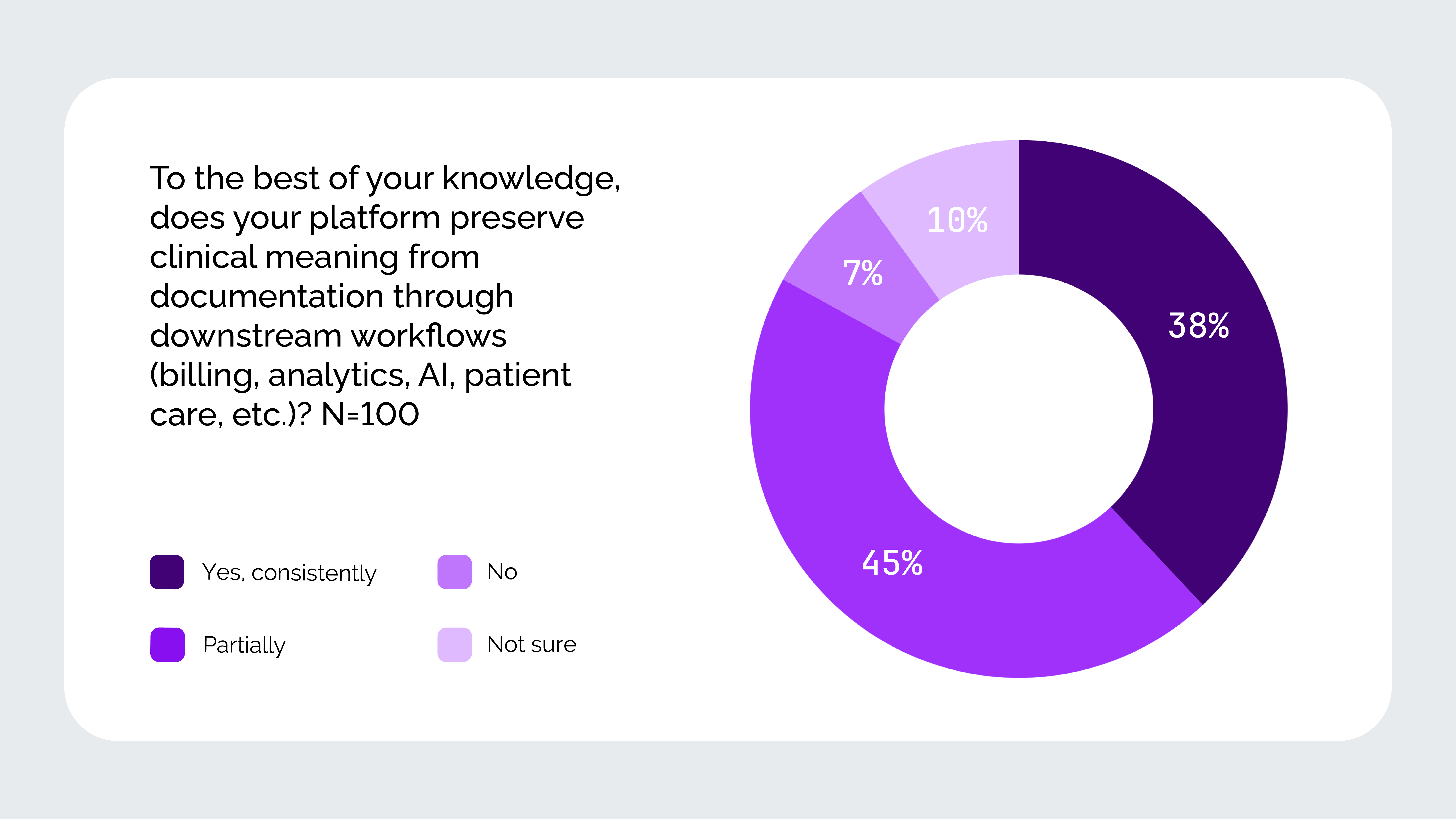
Nearly three-quarters of survey respondents rated diagnostic specificity as critical or very important to product value. Yet only 38% said their platform consistently preserves clinical meaning from documentation through downstream workflows, while 45% said they do so only partially.
3. Knowledge infrastructure is becoming strategic, but adoption varies
The survey shows strong interest in clinical knowledge graphs as a foundation for reliable AI. Respondents pointed to grounding LLM outputs in clinical truth, supporting explainability, normalizing data, resolving concepts, and improving diagnostic specificity as high-value use cases.
As models become easier to access, durable advantage moves to the knowledge layer around the model: the concepts, relationships, rules, mappings, and context that help AI interpret healthcare data correctly.
For organizations building AI in healthcare, that means investing in a trusted clinical knowledge layer that can consistently ground model outputs. That’s where IMO Health’s Knowledge Graph adds value; it gives builders a governed clinical context layer, so models can reason against clinical truth instead of pattern matching alone.
The survey suggests the market is moving in this direction, but implementation remains mixed. Only 4% said their organization is fully prepared to integrate a knowledge graph into its AI stack today. At the same time, nearly half are likely or certain to invest within 24 months, and another third are somewhat likely.
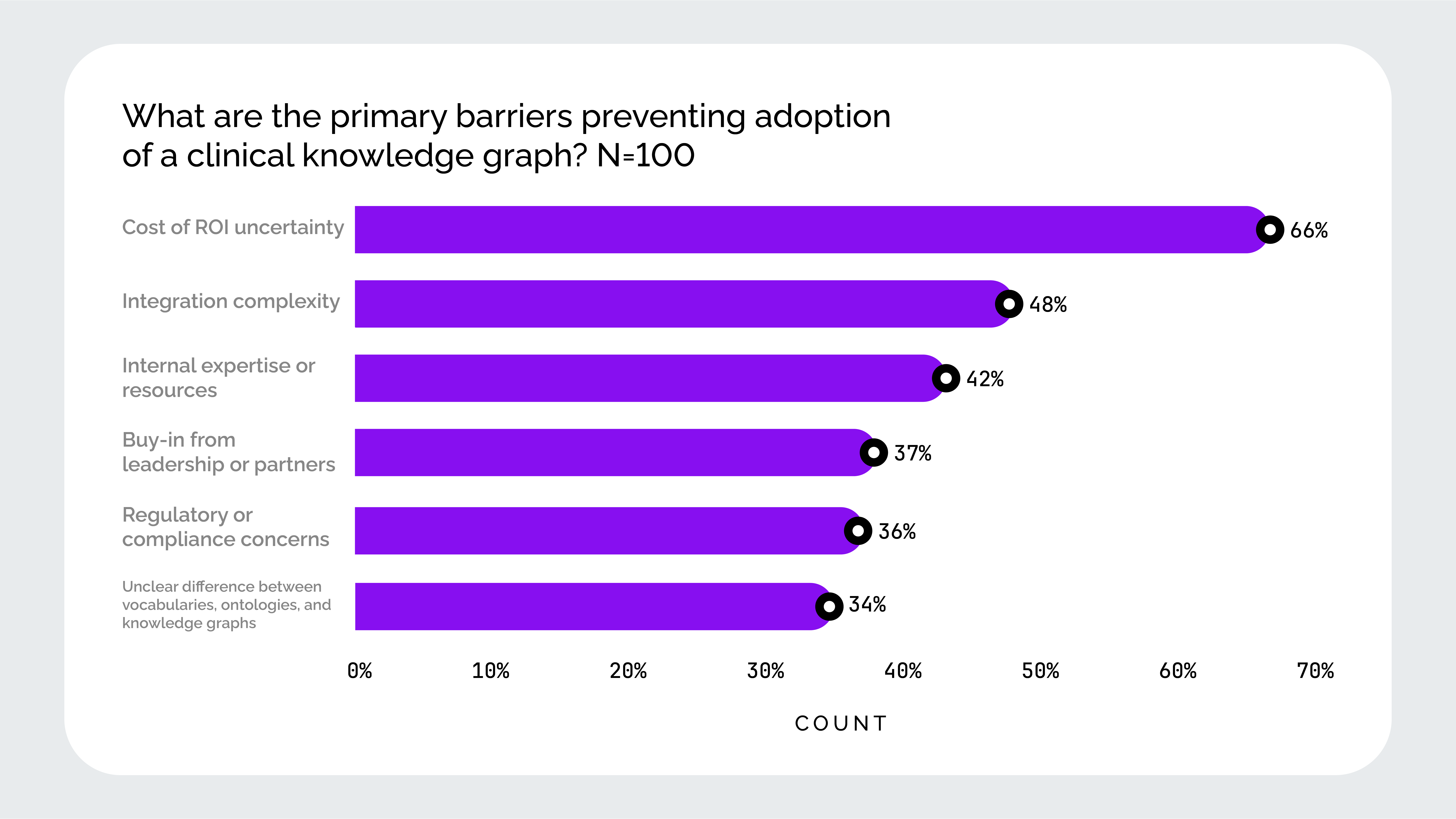
The barriers are practical: cost or ROI uncertainty, integration complexity, internal expertise, leadership buy-in, regulatory concerns, and confusion about vocabularies, ontologies, and knowledge graphs. Successfully adopting AI requires coordinated product, commercial, operational, and governance decisions.
The barriers are practical: cost or ROI uncertainty, integration complexity, internal expertise, leadership buy-in, regulatory concerns, and confusion about vocabularies, ontologies, and knowledge graphs. Successfully adopting AI requires coordinated product, commercial, operational, and governance decisions.
The next phase of clinical AI depends on readiness, not hype.
To close the readiness gap, leaders must look beyond model selection and ask whether their systems can preserve clinical meaning, resolve inconsistent data, explain outputs, and support decisions with confidence.
IMO Health solves that challenge by giving health tech companies the clinical data intelligence, terminology, and knowledge infrastructure needed to turn AI into a trusted product capability.
As AI adoption accelerates, the quality of that foundation will determine which AI products deliver lasting value.


