


Company profile
A leading biotechnology company that invents, develops, and commercializes life-transforming medicines for people with serious diseases.
The challenge
For a global pharmaceutical organization, systematic literature reviews (SLRs) had become a growing bottleneck in evidence generation. Across therapeutic areas, teams were managing multiple concurrent reviews – each requiring thousands of abstracts to be screened and extensive data extraction. These efforts were essential for supporting regulatory submissions and informing health technology assessment (HTA) decisions, but the process was slow, resource-intensive, and difficult to scale.
Timelines often stretched from six to more than sixteen months, placing strain on internal teams and delaying downstream activities. At the same time, the organization couldn’t afford to compromise rigor. Every review needed to meet strict standards for accuracy, transparency, and regulatory defensibility.
Facing increasing evidence demands, the organization needed a way to accelerate SLR workflows without sacrificing quality or control.
The approach
The organization implemented an AI-assisted SLR workflow to support key stages of the review process, including:
- Search strategy and query development
- Protocol definition using PICOs* criteria
- AI-enabled abstract screening
- Structured data extraction
- Evidence summarization
The workflow was designed with a human-in-the-loop model, enabling subject-matter experts to guide inclusion criteria, refine prompts, and maintain oversight throughout.
Rather than replacing reviewers, the approach positioned AI as a collaborator – rapidly triaging large volumes of literature while preserving methodological control, transparency, and consistency.
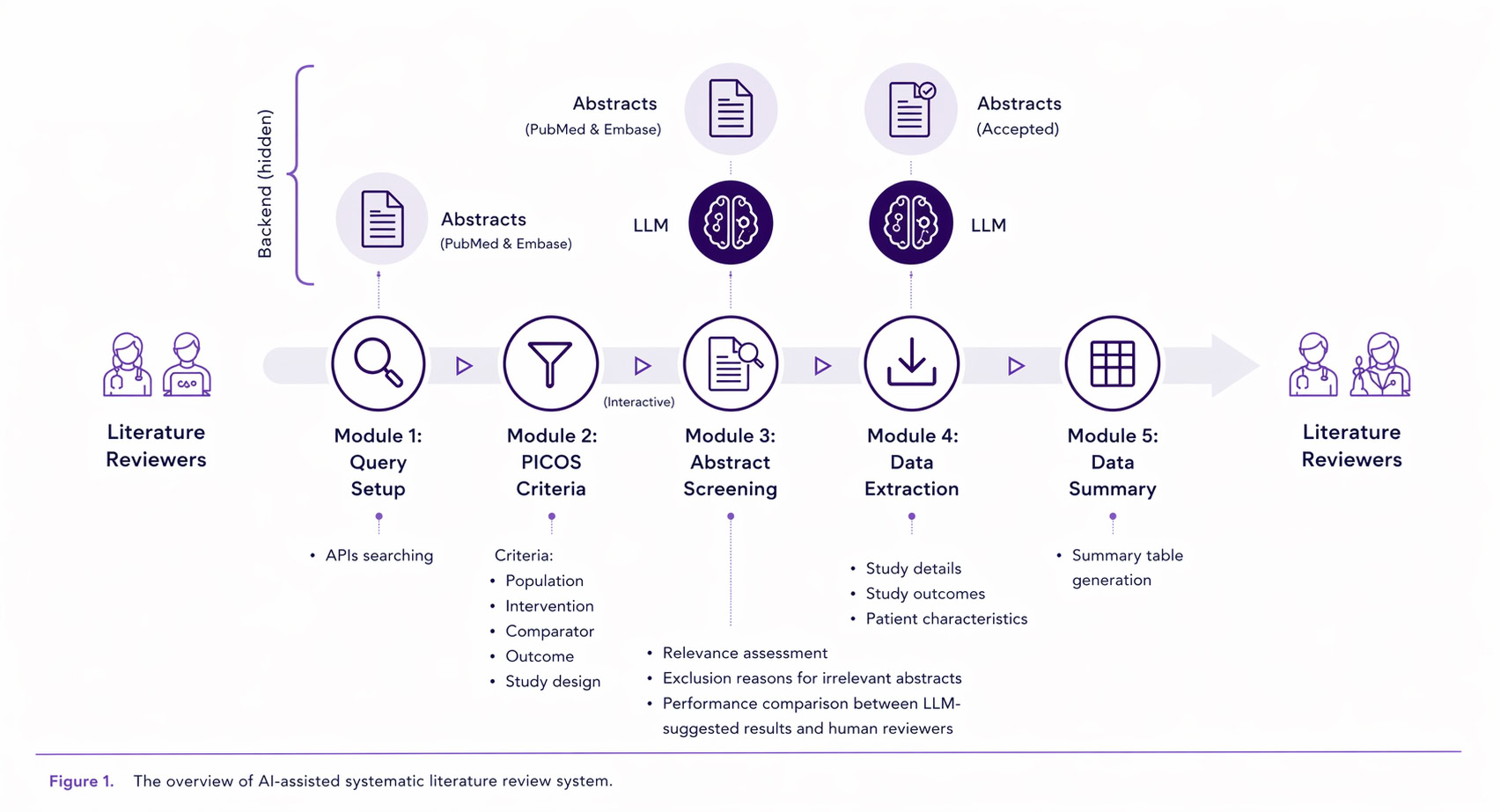
Li Y, Datta S, Rastegar-Mojarad M, et al. Enhancing systematic literature reviews with generative artificial intelligence: development, applications, and performance evaluation. Journal of the American Medical Informatics Association. April 2025. Accessed via: https://doi.org/10.1093/jamia/ocaf030
Results
In evaluating the AI-assisted workflow against human review, the organization demonstrated strong performance across both screening and extraction, with metrics approaching expert-level agreement.
Abstract screening
- 90% sensitivity, ensuring high recall of relevant studies
- 89% accuracy in inclusion/exclusion decisions
- Cohen’s κ = 0.71, indicating substantial agreement with human reviewers
Data extraction
- F1 score: 93, reflecting strong precision and recall
- Up to 97% accuracy in identifying exclusion rationales
Together, these results show that AI-assisted workflows can achieve near-expert performance while significantly reducing manual effort.
Impact
Leveraging AI paired with expert oversight, the organization accelerated and scaled core components of the SLR process without compromising quality to:
- Reduce manual burden across screening and extraction
- Maintain high sensitivity and precision
- Deliver structured, regulator-ready evidence outputs
Importantly, the workflow preserved transparency, reproducibility, and governance – ensuring outputs remained defensible for regulatory and health technology assessment (HTA) use.
Why it matters
Evidence demands are rapidly increasing, driven by precision medicine, rare disease research, and growing global regulatory scrutiny. At the same time, traditional SLR methods remain difficult to scale.
AI-assisted approaches offer a new model for evidence generation, combining human oversight, transparent logic, and high-performance metrics.
By accelerating literature review without sacrificing rigor, organizations can move faster with confidence – improving trial design, strengthening regulatory strategy, and enabling more effective market access.
To learn more about IMO Health’s SLR solution, click here.
*Population, Intervention, Comparison, and Outcome.


