


- Healthcare data requires structure, context, and meaning to be usable in clinical and AI applications
- Knowledge graphs model healthcare as connected concepts, preserving relationships across diagnoses, treatments, and outcomes
- Clinical language, ontology alignment, and provenance make healthcare knowledge graphs uniquely complex to build
- Effective knowledge graphs depend on semantic precision, real-world data, and terminology expertise to support trustworthy decision-making
What is a knowledge graph – and why does it matter in healthcare?
A knowledge graph is a data model that organizes information as an interconnected network of entities (nodes) and their relationships (edges). Unlike relational databases, which store data in a rigid schema, knowledge graphs model and organize information in a way similar to how clinicians and researchers think: as a web of connected concepts.
This framework is important in healthcare because medical knowledge is interconnected. For example, a drug doesn’t live alone. Drugs have mechanisms of action; they act on proteins, interact with other drugs, and induce side effects that impact different patient populations. Knowledge graphs are great at representing this complexity.
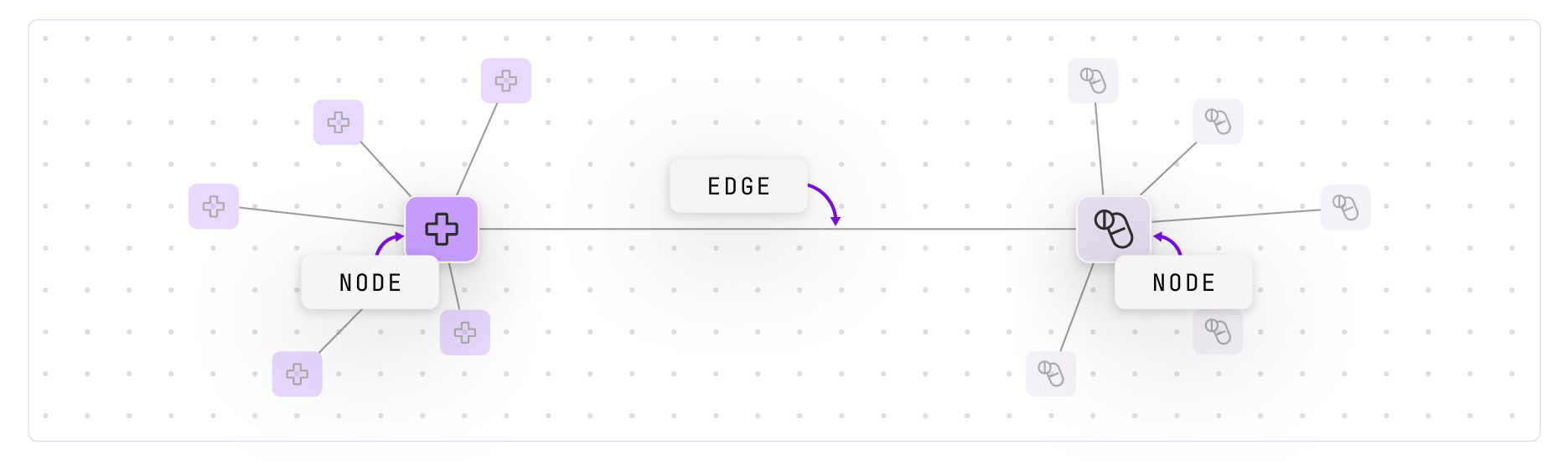
Let’s take a deeper look at what knowledge graphs enable:
AI and machine learning boost: Knowledge graphs are essential foundations of rigorous AI systems. When an AI model is trained on flattened tables, they lose medicine’s inherent structure – the interconnected relationships that drive healthcare. Knowledge graphs offer structured fact-checked data, which allows large language models (LLMs) to ground their responses, reducing hallucinations while increasing accuracy. Knowledge graphs also enable retrieval-augmented generation (RAG), allowing models to query relevant medical knowledge before generating recommendations. The fusion of knowledge representation and AI makes this kind of system auditable and thus more trustworthy in clinical practices where anything that explains the “why” behind these predictions is desirable.
Clinical decision support: Knowledge graphs can link patient data with medical literature, drug databases, and clinical guidelines that can sometimes reveal potential treatment options, flag possible contraindications, and inform diagnoses for patients who might benefit from specific treatments.
Drug discovery and repurposing: Knowledge graphs can surface hidden relationships between physiological processes, medications, and diagnoses that might not be apparent when data is scattered across disconnected sources. This effect is especially powerful when different types of data are combined: the graph can reveal the complete clinical picture.
Precision medicine: To help users understand which treatments may be most appropriate for which patient cohorts, knowledge graphs integrate genomic data, clinical phenotypes, expert guidelines, and treatment outcomes.
Research acceleration: Researchers use knowledge graphs to help identify gaps in knowledge and generate new hypotheses. This is done by linking publications, clinical trials, molecular pathways, and real-world evidence.
Semantic richness and trustworthiness are the key advantages of a knowledge graph in health tech and life sciences. Unlike simple databases that just store data, knowledge graphs encode meaning and context. AI systems and human specialists can then reason over complex medical information in ways that traditional databases cannot.
Why healthcare data is broken – and how knowledge graphs fix it
Healthcare itself doesn’t have a problem with data, but it does have a structure problem. If you think about it, hospitals generate large amounts of data every day – diagnoses, medications, labs, results, images, observations, and clinical notes. On paper, it looks like we should be able to answer almost any clinical question; but when teams try to build on top of this data, something specific becomes very clear: The data exists, but the context doesn’t. And in healthcare, context is everything.
Live health system data is not clean or standardized. It requires:
- Interoperability frameworks like HL7 FHIR
- Alignment with terminologies such as SNOMED CT®, ICD-10-CM, LOINC®, CPT®, and RxNorm® (amongst others)
- Normalization of inconsistent coding
- Handling missing or fragmented records
- Designing for privacy and compliance
Healthcare data isn’t just information; it’s clinical language, context, and meaning. A knowledge graph is key to this framework, modeling clinical data the way it actually works:
- Patient → diagnosed with → Type 2 diabetes
- Patient → prescribed → metformin
- Metformin → interacts with → warfarin
- Patient → lab result → HbA1c (8.4%)
A knowledge graph maintains these relationships instead of siloing this information, as is common in a Relational Database Management System (RDBMS). Instead of treating comorbidities as isolated, unrelated datapoints, it maintains information about their relationships. This is a conceptual shift in how we model and think about healthcare data.
On paper, it looks like we should be able to answer almost any clinical question; but when teams try to build on top of this data, something specific becomes very clear: The data exists, but the context doesn’t. And in healthcare, context is everything.
Vidhya Sivakumaran, PhD
The key to this conceptual shift is where IMO Health’s terminology experience becomes not only the semantic layer but also the knowledge infrastructure. Over years of working closely with medical terminologies and real-world clinical datasets, we’ve learned that the hardest part of healthcare data isn’t modeling, but meaning.
Why do knowledge graphs and clinical language present such unique challenges?
The structural constraints of the graphs themselves and the intricacy of the clinical language they must represent make it challenging to create efficient knowledge graphs for the healthcare industry.
Structural limitations of knowledge graphs
Insufficient domain coverage: Clinical depth is lacking in generic knowledge graphs. They may know metformin treats diabetes, but could miss dose-response relationships, drug-drug interactions, or escalation criteria. This is especially true when these graphs are developed in isolation from clinical reality, rather than being created and refined through constant real-world patient-provider interactions.
Insufficient relationship typing: In medicine, accuracy is necessary to distinguish between causes, treatments, contraindications, and increased risk. Because vague relationships cannot facilitate clear decision-making, generic relationships such as “associated with” are too ambiguous for clinical use.
Ontology misalignment: ICD-10-CM, SNOMED CT, UMLS, and MeSH are standards used in the healthcare industry. Missed connections, duplication, and fragmentation result from poor mapping among these.
Lack of provenance: Clinicians need to know not just what the graph claims, but where it came from and how current it is. Without provenance tracking, evidence-based practice becomes impossible to support.
The complexity of clinical language
Ineffective use of medical terminology: The terms “myocardial infarction,” “MI,” and “heart attack” all refer to the same thing. Many graphs are unable to bring these differences together because they assume that someone else has already done the work of harmonizing these terms. Additionally, they have trouble with temporal expressions (“resolved pneumonia”), negation (“no evidence of PE”), and uncertainty (“possible appendicitis”).
Semantic precision: Even minor variations can have profound effects. With a three-letter difference, “hypoglycemia” and “hyperglycemia” are nearly opposites. “Distal” and “proximal” completely reverse anatomical meaning. Models that assume that terms with similar appearances have similar meanings will make risky mistakes.
Even minor variations can have profound effects. With a three-letter difference, "hypoglycemia" and "hyperglycemia" are nearly opposites. "Distal" and "proximal" completely reverse anatomical meaning. Models that assume that terms with similar appearances have similar meanings will make risky mistakes.
Vidhya Sivakumaran, PhD
Context collapse: Context affects the clinical meaning. For example, a potassium of 5.5 mEq/L may be critical for some patients while acceptable for others on ACE inhibitors. When contextual information is removed from a graph, it becomes oversimplified.
What should health tech and life sciences teams look for in a knowledge graph?
Not all knowledge graphs are built for clinical environments. When evaluating solutions, organizations should prioritize the following:
- Ontology coverage and alignment: Mapped to SNOMED CT, RxNorm, LOINC, ICD-10-CM, and domain-specific standards like HPO and ChEBI, with clear processes for keeping them current.
- Relationship precision: Clinically meaningful relationship types such as treats, causes, contraindicates, increases risk of – not generic “associated with” links.
- Provenance: Every assertion traceable to a source, with evidence of quality levels that are filterable. This is non-negotiable for regulatory compliance and clinical trust.
- Contextual and linguistic handling: Validated performance on negation, uncertainty, temporality, and abbreviations – tested on data representative of your actual use case.
- Reasoning capabilities: Support for multi-hop inference, not just pattern matching.
- Integration: API access, FHIR/HL7 compatibility, and support for standard query languages.
- Explainability: Clear reasoning paths that clinicians and regulators can audit.
Bringing structure, context, and meaning to healthcare data
Healthcare organizations generate vast amounts of data and making that data usable can pose a significant challenge. When information is disconnected or devoid of context, it becomes difficult to trust and leverage downstream.
Knowledge graphs address this by organizing information as a web of connected concepts, preserving the relationships that drive healthcare. They maintain how diagnoses, medications, lab results, and clinical context fit together, allowing AI systems and human experts to reason over complex medical information in ways that traditional databases cannot.
Schedule a demo to learn more about our pioneering knowledge graph and how it grounds AI in precise clinical truth.
RxNorm® is a registered trademark of the National Library of Medicine.
SNOMED and SNOMED CT are registered trademarks of SNOMED International.


